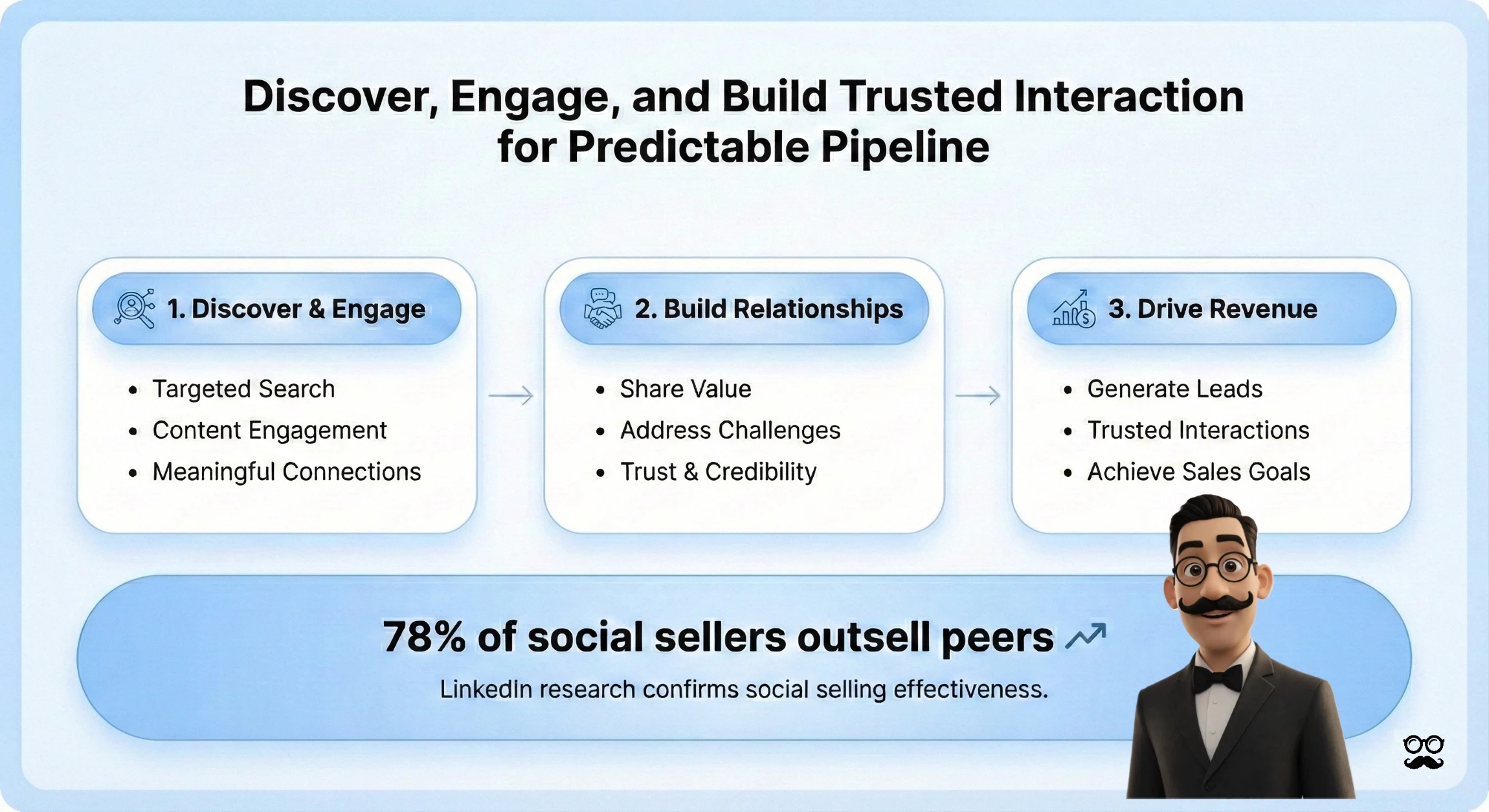
LinkedIn social selling is the practice of using LinkedIn to discover, engage, and build one-to-one relationships with prospects—generating leads and driving sales through trusted interactions rather than immediate sales pitches. This comprehensive guide provides sales professionals, founders, and B2B teams with a practical framework, proven tactics, and the right tools to generate predictable pipeline through relationship-based selling on LinkedIn.
In today's B2B landscape, buyers research independently, validate solutions through peer recommendations, and prefer engaging with professionals who demonstrate genuine expertise. According to LinkedIn's research, 78% of social sellers outsell their peers who don't use social media. LinkedIn social selling aligns with this modern buying behavior, replacing cold outreach with strategic relationship-building that drives measurable revenue results.
The Social Selling framework is straightforward:
- Optimize your LinkedIn profile to demonstrate expertise and value
- Identify the right prospects using advanced search and targeting
- Engage thoughtfully before sending connection requests
- Share valuable content that addresses your audience's challenges
- Personalize outreach with specific context and relevance
- Move conversations forward at the right pace based on relationship signals
What Is Social Selling on LinkedIn? (Definition & Framework)
Definition
LinkedIn social selling is the method of using LinkedIn to discover, engage, and build one-to-one relationships with prospects so you can generate leads and drive sales through trusted interactions—not immediate sales pitches. As LinkedIn defines it, social selling is a strategic method for sellers to connect and build relationships with prospects through social networks. Social selling leverages your social network to find the right candidates, build meaningful connections, and achieve your sales goals by developing relationships as part of the sales process.
Unlike traditional cold outreach, social selling focuses on:
- Discovering potential prospects through targeted search and engagement
- Building trust and credibility before making sales pitches
- Creating one-to-one relationships rather than broadcasting to many
- Sharing valuable content that addresses your audience's challenges
- Moving conversations forward at the right pace based on relationship signals
A Practical Social Selling Framework (6 Steps)
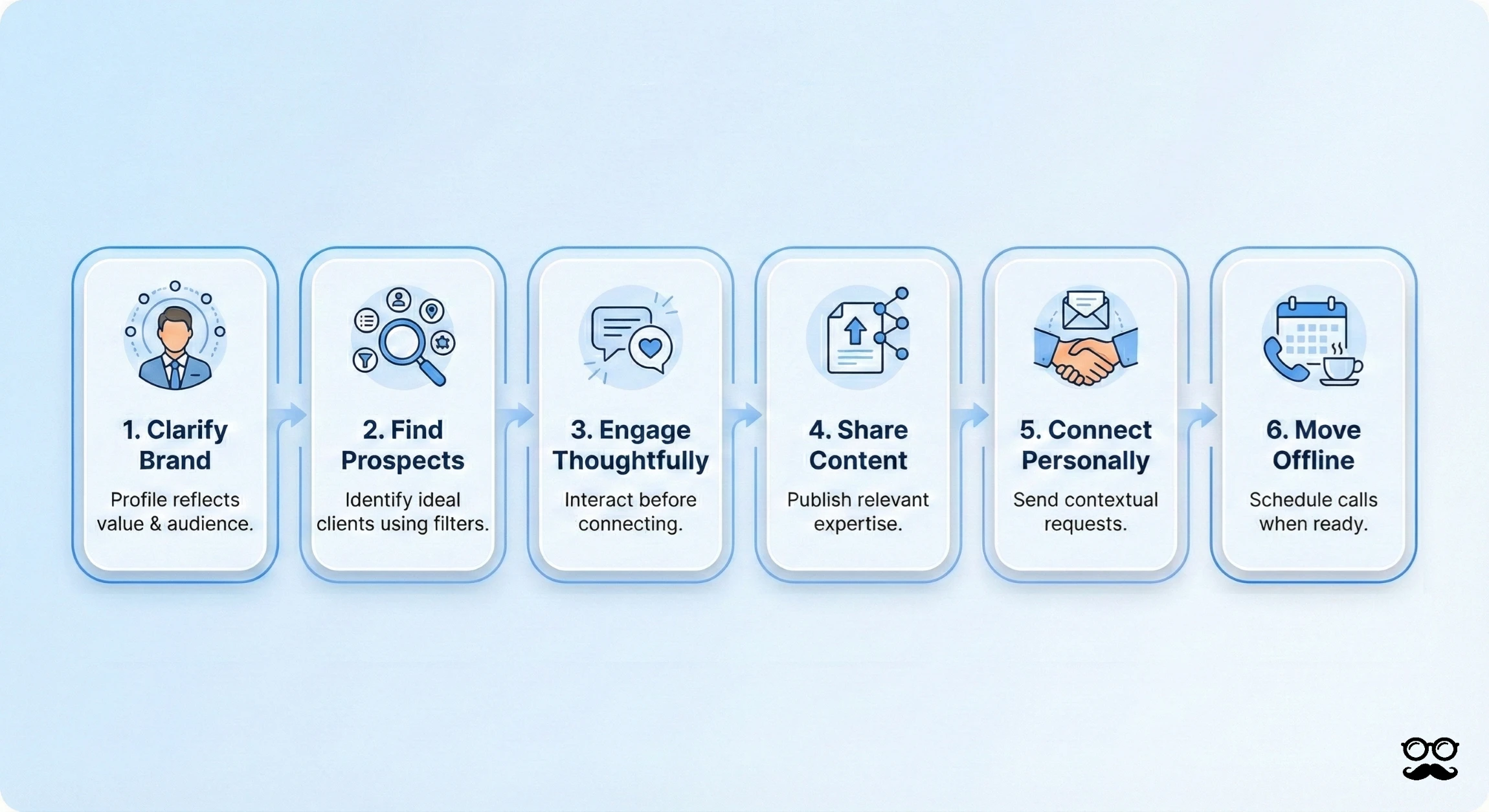
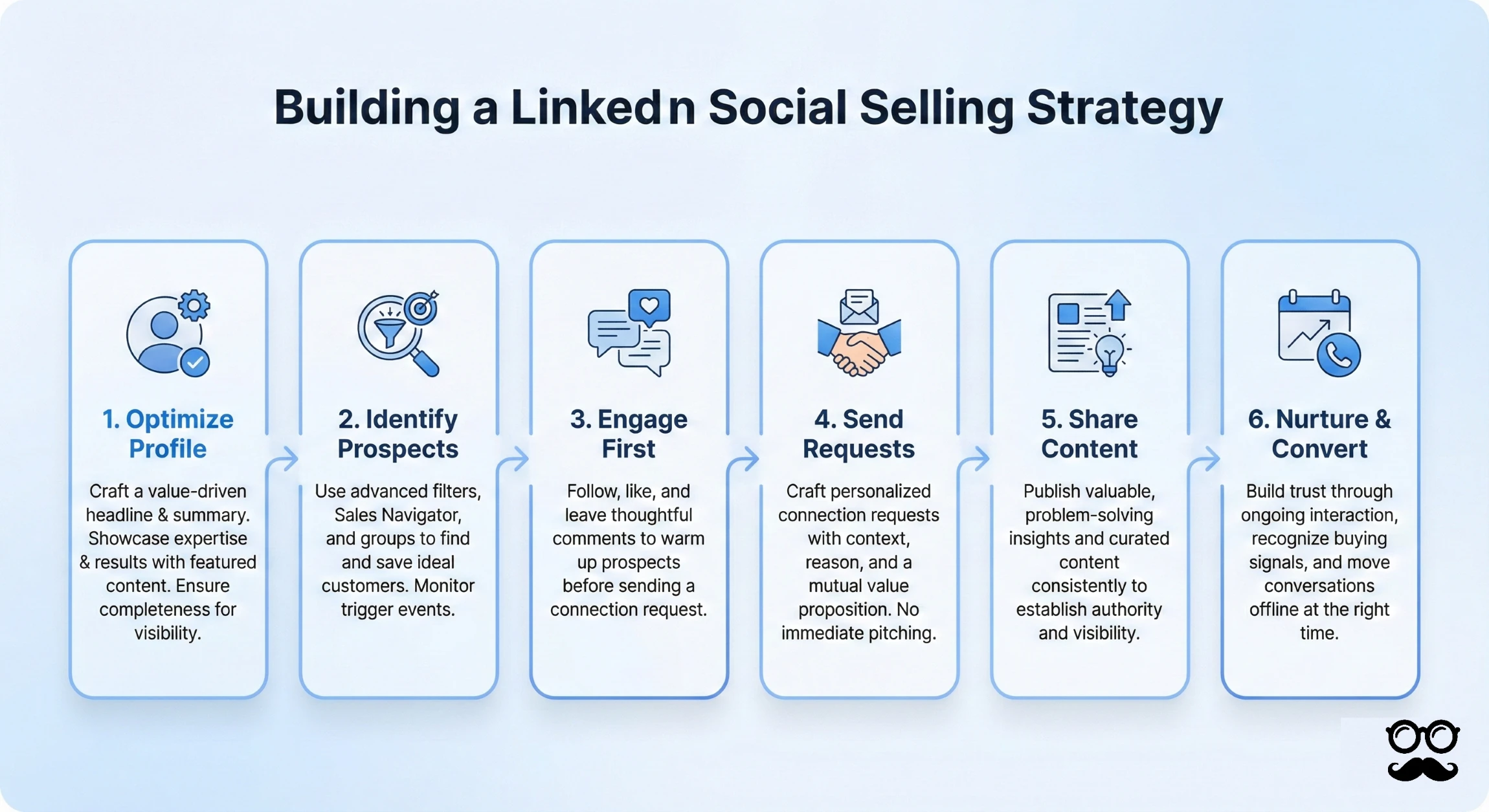
Social selling on LinkedIn follows a clear, repeatable process. Here's the framework that drives results:
- Clarify your professional brand – Your profile and positioning should clearly reflect what you do, who you help, and the value you provide
- Find potential prospects – Use LinkedIn search, Sales Navigator, groups, and filters like role, location, and industry to identify your ideal customers
- Engage thoughtfully – Interact with prospects' posts, leave meaningful comments, and stay visible before sending connection requests
- Share relevant content – Publish or share content that speaks directly to your audience's problems and demonstrates your expertise
- Connect with a personalized request – Include specific context on why you're reaching out and how you can provide value
- Move the conversation offline at the right time – Schedule a call or meeting once you've established real communication flow and trust
Social Selling vs Social Marketing: Key Differences
Understanding the distinction between social selling and social marketing helps clarify your approach:
Social Selling:
- Led by sales professionals and individual contributors
- Focused on one-to-one relationship building
- Aims to generate qualified leads and close deals
- Measured by connections, conversations, and pipeline
Social Marketing:
- Led by marketing teams and brand managers
- Focused on one-to-many messaging and brand awareness
- Aims to build audience, generate demand, and create visibility
- Measured by reach, engagement, and brand metrics
Tools That Support the Social Selling Process
Effective social selling requires the right technology stack to track activity and scale your efforts:
- CRM systems help track prospect interactions, conversation history, and deal progress
- Marketing automation provides visibility into prospect behaviors once conversations move offline—website visits, landing pages, email engagement, and social assets
- LinkedIn automation tools like Meet Alfred support prospecting, multi-channel outreach, and relationship management without changing the fundamental relationship-first approach
- Analytics platforms measure what's working and help optimize your social selling strategy over time
Why LinkedIn Social Selling Matters for B2B Sales Teams
The Modern Buyer's Journey
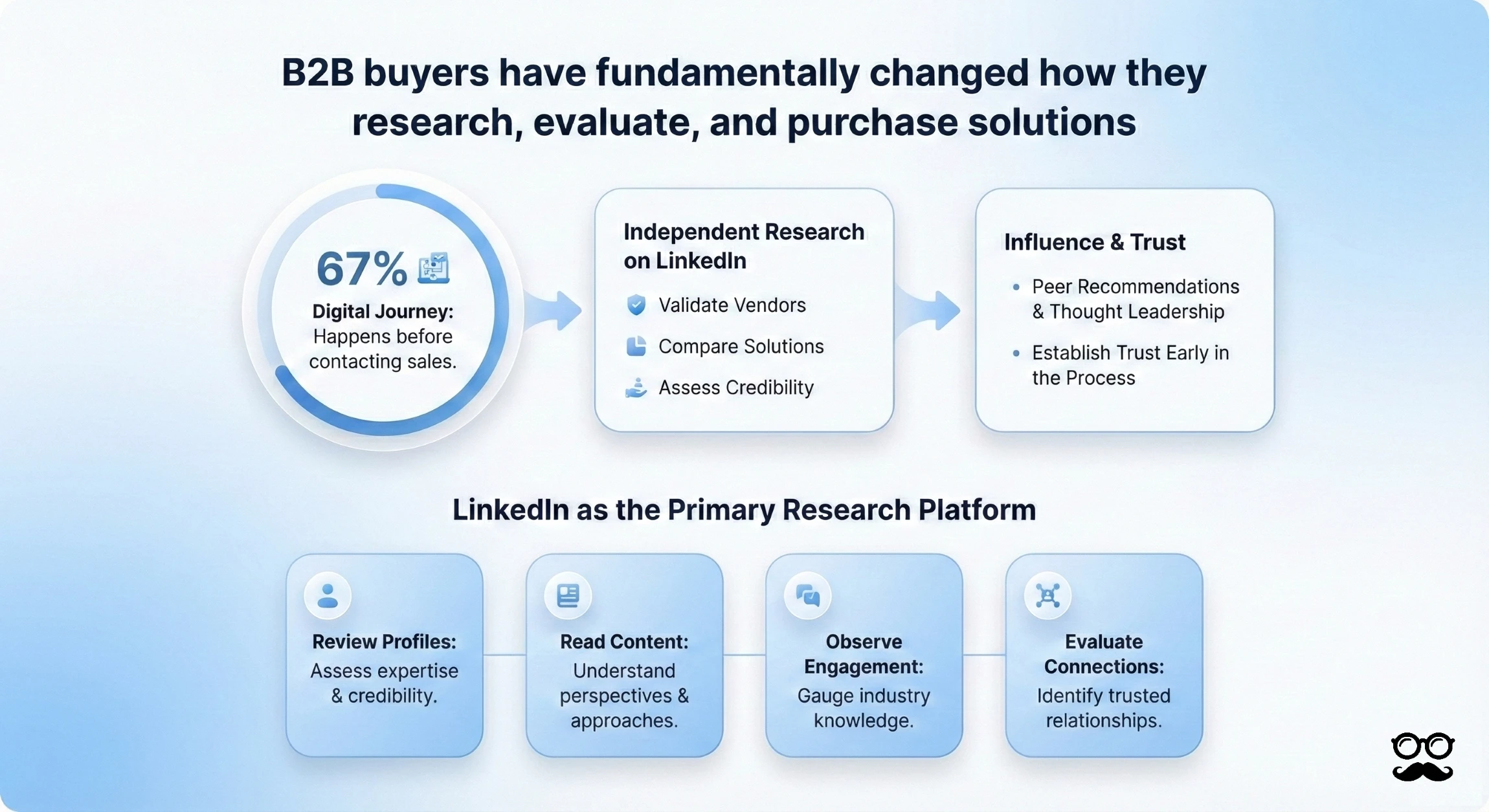
B2B buyers have fundamentally changed how they research, evaluate, and purchase solutions:
- 67% of the buyer's journey happens digitally before prospects ever contact sales
- Buyers conduct independent research on LinkedIn to validate vendors, compare solutions, and assess credibility
- Peer recommendations and thought leadership influence purchase decisions more than traditional advertising
- Trust must be established early in the buying process—before prospects are ready for sales conversations
LinkedIn serves as the primary research platform where buyers:
- Review profiles to assess expertise and credibility
- Read content to understand perspectives and approaches
- Observe engagement to gauge industry knowledge
- Evaluate connections to identify trusted relationships
How Social Selling Impacts Sales Metrics
When implemented effectively, LinkedIn social selling delivers measurable improvements across key performance indicators:
Lead Quality and Conversion Rates:
- Warmed prospects convert at higher rates than cold outreach
- Pre-existing engagement signals stronger buyer intent
- Relationship context allows for more relevant conversations
Sales Cycle Length:
- Trust established during social selling shortens evaluation periods
- Content shared during engagement educates prospects earlier
- Fewer touchpoints needed to advance qualified opportunities
Win Rates and Deal Size:
- Relationships built on expertise command premium positioning
- Multi-threaded engagement through social connections increases deal confidence
- Trusted advisors win competitive situations more frequently
Pipeline Predictability:
- Consistent engagement creates reliable lead flow
- Relationship signals provide early warning on deal health
- Social selling metrics correlate with downstream revenue
The Business Case for Social Selling Investment
Organizations that commit to social selling see tangible returns. According to LinkedIn's Social Selling Index research:
- Sales professionals with higher Social Selling Index (SSI) scores create 45% more opportunities
- Teams using social selling techniques are 51% more likely to hit quota
- Social selling reduces dependency on expensive paid channels
- Employee advocacy through social selling amplifies brand reach without proportional cost increases
How to Build Your LinkedIn Social Selling Strategy (Step-by-Step)
Step 1: Optimize Your LinkedIn Profile for Social Selling
Your LinkedIn profile serves as your digital storefront. Position it as a valuable resource—not just a resume:
Headline Optimization:
- Focus on who you help and the results you deliver
- Avoid generic titles like "Sales Professional" or "Account Executive"
- Include keywords your prospects search for
- Example: "Helping B2B Sales Teams Generate Predictable Pipeline Through LinkedIn Automation"
Summary Section:
- Lead with your customer's challenges, not your career history
- Explain your approach and philosophy
- Include specific results or outcomes you've helped clients achieve
- End with a clear call-to-action
Experience and Featured Content:
- Highlight relevant experience that demonstrates expertise
- Showcase case studies, articles, or resources in your Featured section
- Include media, presentations, or testimonials that build credibility
- Update regularly to signal active engagement
Profile Completeness:
- Add a professional photo (profiles with photos receive 21x more views)
- Include a custom background image that reinforces your brand
- Request recommendations from clients and colleagues
- Ensure all sections are complete for maximum search visibility
Step 2: Identify and Target the Right Prospects
Effective social selling starts with finding the right people:
LinkedIn Search Strategies:
- Use advanced search filters: location, industry, company size, seniority level
- Search for people based on job titles, skills, and keywords
- Explore 2nd and 3rd-degree connections for warm introduction paths
- Save searches to monitor new prospects matching your criteria
Sales Navigator for Advanced Prospecting:
- Access extended filters including company headcount growth, technologies used, and recent job changes
- Build lead lists organized by account, territory, or campaign
- Set up alerts for trigger events like job changes or company news
- Track who's viewed your profile and engage strategically
Understanding why Sales Navigator matters for modern prospecting helps you leverage its full capabilities for discovering and tracking high-value prospects in your target market.
LinkedIn Groups for Prospect Discovery:
- Join groups where your ideal customers congregate
- Participate authentically in discussions (don't pitch immediately)
- Use group member directories to identify prospects
- Note: group members can message you even without connections
Meet Alfred's Lead Finder:
- Automate prospect discovery based on your ideal customer profile
- Build targeted lists faster than manual search
- Integrate with your existing sequences and campaigns
- Export qualified prospects directly to your CRM
Step 3: Engage Before You Connect
Warming up prospects before sending connection requests dramatically improves acceptance rates and conversation quality:
The Engagement Sequence:
- Find prospects who match your ideal customer profile
- Follow their profiles to see their content in your feed
- Like their posts to get on their radar (1-2 posts over several days)
- Leave thoughtful comments that add perspective or ask genuine questions
- Share their content with your network (with added context)
- Wait 5-7 days before sending a connection request
Meaningful Engagement Best Practices:
- Comment with substance—avoid generic responses like "Great post!"
- Reference specific points they made
- Add your own experience or perspective
- Ask questions that prompt discussion
- Be genuine, not salesy
Why This Approach Works:
- Prospects see your name multiple times before you connect
- You demonstrate interest in their perspective, not just selling
- Engagement establishes you as a thoughtful professional
- Connection requests feel natural, not random
Step 4: Send Personalized Connection Requests
When you've warmed up the relationship through engagement, craft connection requests that convert:
Connection Request Framework:
- Reference point – Note where you found them or what you have in common
- Reason – Explain specifically why you want to connect
- Value proposition – Suggest how the connection could be mutually beneficial
- No immediate ask – Don't pitch products or services in the request
Example Connection Messages:
Example 1 (Engagement Reference):
"Hi [Name], I've enjoyed your posts about sales enablement—particularly your recent thoughts on training ROI. I work with B2B teams on similar challenges and would value connecting to share insights."
Example 2 (Mutual Connection):
"Hi [Name], I noticed we're both connected with [Mutual Connection] and work in the sales automation space. Would be great to connect and learn more about your work at [Company]."
Example 3 (Group/Content Reference):
"Hi [Name], I came across your article on multi-channel outreach in the [Group Name] group. Really smart perspective on sequencing. I'd enjoy connecting to share ideas on this topic."
What to Avoid:
- Generic requests with no context
- Immediately pitching services or products
- Copy-paste messages that feel automated
- Requests longer than 300 characters (LinkedIn's limit)
Step 5: Share Content That Solves Problems
Consistent, valuable content establishes your expertise and keeps you visible to your network:
Content Strategy Principles:
- Focus on your audience's challenges, not your company's features
- Share actionable insights people can implement immediately
- Mix original content with curated content (70/30 split)
- Post consistently (2-3 times per week minimum)
- Vary content formats: text posts, articles, documents, videos, polls
Content Types That Drive Engagement:
- Industry insights – Share trends, data, or analysis relevant to your audience
- Practical tips – Offer frameworks, templates, or how-to guidance
- Case studies – Demonstrate results without being overly promotional
- Thought leadership – Take positions on industry debates or challenges
- Behind-the-scenes – Humanize your brand with authentic stories
- Curated content – Share others' insights with your perspective added
Content Best Practices:
- Hook readers in the first 2 lines (before "see more")
- Use short paragraphs and white space for readability
- Include relevant hashtags (3-5) to expand reach
- Tag people mentioned or featured (with permission)
- Respond promptly to comments to boost algorithm visibility
- Post during business hours when your audience is active
For sales teams looking to amplify their reach, using Sales Navigator for LinkedIn content distribution enables precise targeting of decision-makers who will find your content most valuable.
Meet Alfred's Social Media Posting:
- Schedule LinkedIn posts in advance
- Maintain consistent visibility without daily manual effort
- Plan content calendars for campaigns or initiatives
- Track engagement metrics to optimize posting strategy
Step 6: Nurture Relationships and Move Conversations Forward
Once connected, focus on building trust and recognizing buying signals:
Relationship Nurturing Tactics:
- Respond promptly to messages and comments
- Continue engaging with their content after connecting
- Share relevant resources without expecting anything in return
- Make introductions to helpful contacts when appropriate
- Provide value first before asking for anything
Conversation Starters That Work:
- Reference something specific from their profile or recent activity
- Ask about challenges they've mentioned in posts
- Share a resource directly relevant to their role or industry
- Offer a perspective on a topic they've discussed
- Request their opinion on an industry trend or development
Recognizing the Right Time to Suggest a Call:
- They've responded positively to multiple messages
- They're asking questions about your approach or experience
- They've shared specific challenges you can address
- Conversation has moved beyond surface-level exchanges
- They've engaged with your content or visited your profile multiple times
Moving to Offline Conversations:
- Acknowledge the value of the LinkedIn conversation
- Suggest a specific reason for talking live
- Offer clear value for their time investment
- Make scheduling easy (provide calendar link or specific options)
- Keep the ask low-pressure—focus on exploration, not sales
Example Transition Message:
"[Name], I've really enjoyed our discussion about [topic]. I have some thoughts on [specific challenge they mentioned] that might be easier to explore in a quick call. Would you be open to a 15-minute conversation next week? Here's my calendar: [link]"
How Employees Benefit from LinkedIn Social Selling
Social selling doesn't just benefit the company—it creates significant value for individual employees:
Build Personal Brand and Thought Leadership
Regular LinkedIn activity establishes employees as recognized experts:
- Visibility within their industry through consistent content sharing
- Recognition as a trusted voice on specific topics or challenges
- Professional credibility that extends beyond their current role
- Network growth with peers, prospects, and industry leaders
- Reputation building that compounds over time
Unlock Future Career Opportunities
Optimized profiles and active engagement lead to inbound opportunities:
- Job offers from companies seeking proven expertise
- Recruiting conversations with better positioning and context
- Speaking engagements at conferences or industry events
- Consulting opportunities leveraging established expertise
- Board positions or advisory roles for experienced professionals
- Media mentions or podcast invitations as subject matter experts
Contribute to Company Success
Social selling allows employees to directly impact business outcomes:
- Drive revenue through personal prospect relationships
- Expand company reach through their professional networks
- Generate qualified leads that move to sales pipeline
- Build company brand as they establish personal credibility
- Create differentiation in competitive markets through authentic relationships
This dual benefit—personal professional growth alongside company success—makes social selling a win-win for both employees and organizations.
How to Get Your Sales Team Engaged in Social Selling
Establish Clear Social Media Guidelines
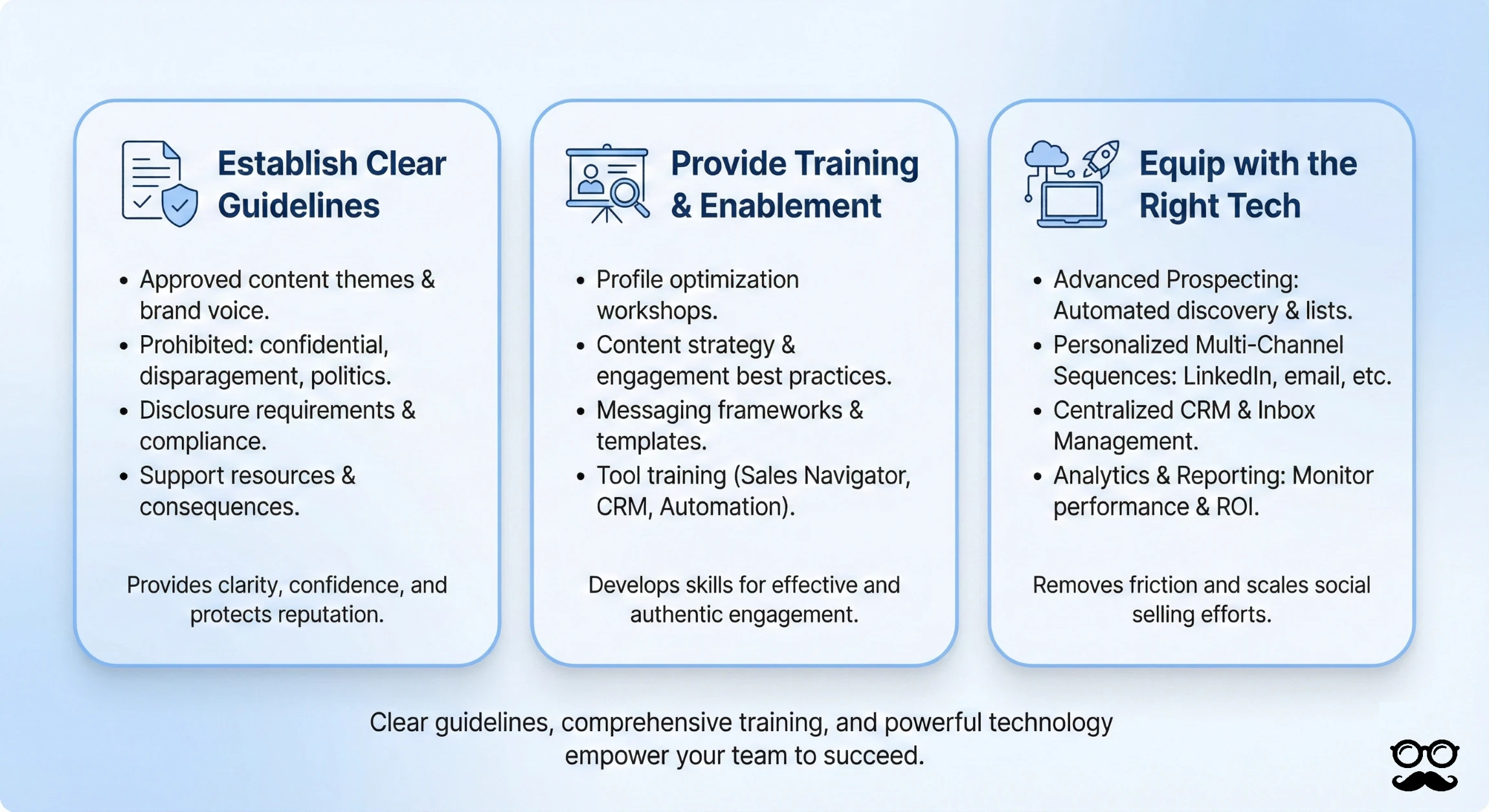
Before launching social selling initiatives, create policies that protect brand reputation while encouraging participation:
What to Include in Guidelines:
- Approved content themes and messaging frameworks
- What's prohibited: confidential information, competitor disparagement, political statements
- Brand voice and tone expectations
- Disclosure requirements (clearly representing the company)
- Consequences for policy violations
- Support resources for questions or guidance
Why Guidelines Matter:
- Provide clarity and confidence for employees new to social sharing
- Protect company reputation and legal compliance
- Set consistent expectations across the team
- Reduce friction and hesitation about participation
- Empower employees to act without constant approval
Provide Training and Enablement
Effective social selling requires skills many sales professionals haven't developed:
Essential Training Components:
- LinkedIn profile optimization workshops – Help reps position profiles for social selling success
- Content strategy training – Teach what to share, when to post, and how to engage authentically
- Messaging frameworks – Provide templates and examples for connection requests and follow-up
- Engagement best practices – Show how to comment meaningfully and build visibility
- Metrics and measurement – Help reps understand what success looks like and how to track it
- Tool training – Ensure everyone knows how to use Sales Navigator, CRM, and automation platforms
Training Delivery Methods:
- Live workshops for interactive learning and practice
- Recorded modules for self-paced learning
- Role-playing exercises for messaging and engagement
- Office hours for ongoing questions and coaching
- Peer sharing sessions to highlight what's working
Equip Teams with the Right Technology
Remove friction by providing tools that make social selling scalable:
Meet Alfred's Platform for Team Social Selling:
Advanced LinkedIn Prospecting:
- Automate prospect discovery based on ideal customer profiles
- Build targeted lists without manual searching
- Track prospect engagement across channels
- Identify warm leads based on activity signals
Personalized Multi-Channel Sequences:
- Create LinkedIn + email + Twitter outreach campaigns
- Maintain personal touch with dynamic personalization
- Automate follow-up while preserving authentic communication
- A/B test messaging to optimize conversion
LinkedIn CRM and Inbox Management:
- Centralize all prospect conversations in one place
- Track interaction history and relationship context
- Manage multiple campaigns simultaneously
- Never lose track of conversation threads
Analytics and Reporting:
- Monitor connection rates, response rates, and conversion metrics
- Track individual and team performance
- Identify top-performing messages and approaches
- Demonstrate ROI and pipeline impact
Team Collaboration Features:
- Share successful sequences and templates
- Coordinate account coverage across team members
- Maintain consistent messaging with shared content libraries
- Scale best practices across the entire sales organization
By combining clear guidelines, comprehensive training, and powerful technology, you remove barriers and make it easy for your entire team to succeed with social selling.
LinkedIn Social Selling Tools and Technology
CRM Integration and Activity Tracking
Customer Relationship Management systems provide the foundation for tracking social selling activity:
Key CRM Capabilities for Social Selling:
- Prospect interaction history – Record every LinkedIn message, comment, and connection
- Website visit tracking – See when prospects visit your site after social engagement
- Email and calendar integration – Connect social conversations to offline interactions
- Deal pipeline visibility – Trace revenue back to social selling sources
- Activity metrics – Measure social touches, response rates, and engagement levels
Meet Alfred's LinkedIn CRM:
- Built specifically for social selling workflows
- Tracks all LinkedIn activity automatically
- Integrates with email outreach for multi-channel visibility
- Provides relationship scoring based on engagement signals
- Syncs with major CRM platforms (Salesforce, HubSpot, Pipedrive)
Marketing Automation for Multi-Channel Outreach
Marketing automation extends social selling beyond LinkedIn:
How Automation Supports Social Selling:
- Email sequences that coordinate with LinkedIn outreach
- Twitter engagement to reach prospects across platforms
- Retargeting based on social media interactions
- Landing page tracking when prospects click shared links
- Content delivery through automated nurture campaigns
Multi-Channel Sequence Strategy:
- Engage with prospect's LinkedIn content
- Send personalized connection request
- Follow up with welcome message
- Deliver valuable content via email
- Re-engage on LinkedIn with relevant insight
- Suggest call or meeting at optimal time
How Meet Alfred Supports Your Social Selling Workflow
Meet Alfred provides the complete automation layer for scalable social selling. To understand how automation integrates with a complete LinkedIn social selling playbook, explore our comprehensive multi-platform guide that covers strategy, execution, and measurement across all channels:
Lead Finder:
- Discover prospects matching your ideal customer profile
- Search across LinkedIn, Sales Navigator, and other sources
- Build targeted lists automatically
- Export to campaigns or CRM instantly
Personalized Multi-Channel Sequences:
- Create sophisticated LinkedIn + email + Twitter campaigns
- Use dynamic personalization for authentic outreach at scale
- Set up conditional logic based on prospect behavior
- Maintain human touch with smart automation
LinkedIn CRM:
- Manage all prospect conversations in one unified inbox
- Track relationship history and engagement context
- Organize prospects by campaign, stage, or custom criteria
- Never miss follow-ups with automated reminders
Analytics and Reporting:
- Monitor key metrics: connection rates, response rates, meetings booked
- Track performance by campaign, team member, or time period
- Identify top-performing messages and sequences
- Demonstrate pipeline impact and ROI
Team Collaboration:
- Share successful sequences and templates across the team
- Coordinate multi-threaded account outreach
- Maintain consistent messaging with content libraries
- Scale individual success to team-wide best practices
AI-Powered Personalization:
- Automatically customize messages based on prospect data
- Generate relevant talking points from profile information
- Adapt messaging based on engagement signals
- Maintain authenticity while operating at scale
Meet Alfred allows you to execute the complete social selling framework—discover prospects, engage authentically, build relationships, and track results—without sacrificing the human, relationship-first approach that drives success.
Common LinkedIn Social Selling Mistakes to Avoid
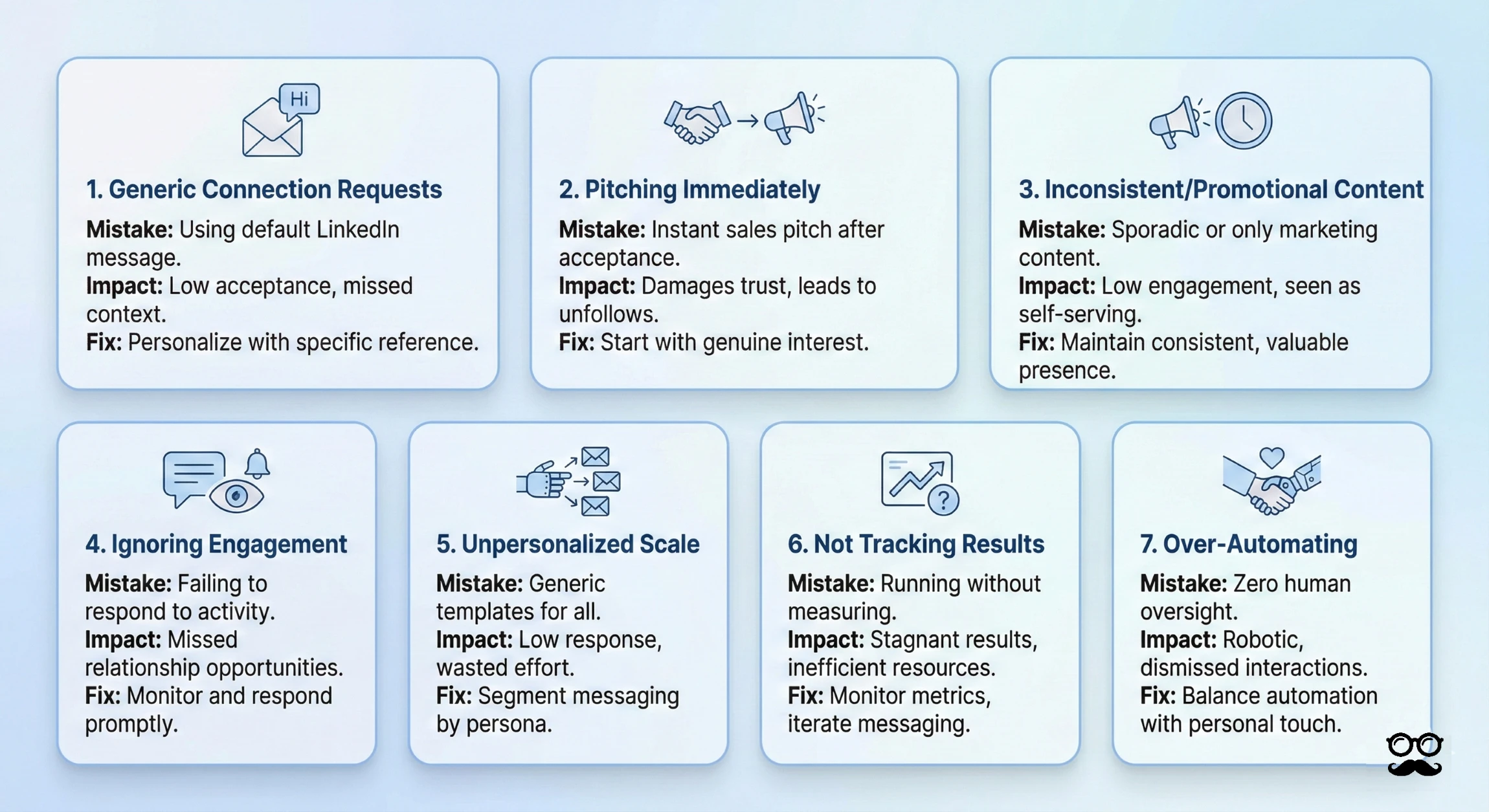
Even experienced sales professionals make these critical errors:
- Sending Generic Connection Requests
- Mistake: Using LinkedIn's default "I'd like to add you to my professional network"
- Impact: Low acceptance rates and missed opportunities to establish context
- Fix: Always personalize with specific reference points or mutual interests
- Pitching Immediately After Connecting
- Mistake: Following connection acceptance with instant sales pitch
- Impact: Damages trust and leads to unfollowing or blocking
- Fix: Start conversations with genuine interest in the prospect
- Posting Inconsistently or Only Promotional Content
- Mistake: Sharing only company marketing materials or posting sporadically
- Impact: Low engagement and perception as self-serving
- Fix: Maintain consistent cadence with 80% valuable content, 20% promotional
- Ignoring Engagement Signals
- Mistake: Failing to respond to comments, profile views, or content engagement
- Impact: Missed buying signals and relationship-building opportunities
- Fix: Monitor notifications and respond promptly to all engagement
- Failing to Personalize Outreach at Scale
- Mistake: Using completely generic templates across all prospects
- Impact: Low response rates and wasted outreach effort
- Fix: Use dynamic personalization fields and segment messaging by persona
- Not Tracking Results or Iterating
- Mistake: Running the same approach without measuring what works
- Impact: Stagnant results and inefficient resource allocation
- Fix: Monitor key metrics and continuously test messaging improvements
- Over-Automating and Losing Authenticity
- Mistake: Setting up pure automation without human oversight or intervention
- Impact: Robotic interactions that prospects immediately recognize and dismiss
- Fix: Balance automation with genuine personal touchpoints
Measuring LinkedIn Social Selling Success
Track these metrics to optimize your social selling approach:
LinkedIn Social Selling Index (SSI)
LinkedIn's proprietary score measures your social selling effectiveness. According to LinkedIn's SSI documentation, the Social Selling Index is a key metric that helps sales professionals understand and improve their social selling performance:
Four SSI Components:
- Establish your professional brand (0-25 points) – Profile completeness and content activity
- Find the right people (0-25 points) – Search activity and prospect identification
- Engage with insights (0-25 points) – Content sharing and interaction quality
- Build relationships (0-25 points) – Connection growth and relationship depth
How to Check Your SSI:
- Visit linkedin.com/sales/ssi to see your current score and industry benchmarks.
What Good Looks Like:
- SSI score above 75: Top quartile of your industry
- Balanced scores across all four dimensions
- Steady improvement over time
Activity Metrics
Track your social selling inputs and consistency:
- Profile views per week – Indicates visibility and reach
- Connection requests sent – Measures outbound activity
- Connection acceptance rate – Gauges targeting and message quality
- Posts published – Tracks content consistency
- Engagement rate on content – Measures content relevance and quality
- Comments left on others' posts – Shows engagement effort
Conversion Metrics
Measure outcomes that directly impact pipeline. For B2B teams specifically, understanding Sales Navigator for B2B prospecting helps you identify and track the right accounts from initial discovery through closed deals:
- Response rate to outreach – Percentage of prospects who engage in conversation
- Meetings booked – Qualified conversations scheduled from LinkedIn activity
- Opportunities created – Pipeline generated from social selling sources
- Pipeline value influenced – Total deal value touched by social selling
- Revenue closed – Actual closed-won revenue attributed to social selling
Meet Alfred Analytics
Meet Alfred provides comprehensive reporting across your social selling activities:
- Real-time dashboard tracking all key metrics
- Campaign-level performance for optimization
- Team benchmarking and leaderboards
- A/B test results for messaging experiments
- ROI calculation connecting activity to revenue
By monitoring these metrics consistently, you identify what's working, eliminate what's not, and continuously improve your social selling results.
The Future of LinkedIn Social Selling
Emerging Trends Shaping Social Selling
AI-Powered Personalization and Insights:
- Advanced AI analyzes prospect profiles to suggest optimal talking points
- Predictive analytics identify high-intent prospects based on behavior patterns
- Natural language generation creates authentic personalized messages at scale
- Sentiment analysis guides conversation tone and approach
Video and Multimedia Content:
- Video posts generate significantly higher engagement than text alone
- Personal video messages create stronger connection than written outreach
- Live streaming enables real-time relationship building
- Rich media formats (documents, carousels, polls) improve content performance
Integration with Account-Based Marketing (ABM):
- Social selling coordinates with targeted account campaigns
- Multi-threaded engagement across buying committees
- Synchronized messaging between social, email, and advertising
- Account-level engagement scoring and insights
Increased Buyer Expectations for Authentic Engagement:
- Buyers demand genuine expertise and valuable interactions
- Tolerance for generic outreach continues declining
- Social proof and peer validation become even more critical
- Relationship-building time investment becomes competitive advantage
Why Social Selling Is Permanent, Not Temporary
Social selling represents a fundamental shift in B2B sales:
- Buyer behavior has permanently changed – Independent research and peer validation are now standard
- Digital-first selling is the new normal – Remote work accelerated already-existing trends
- Trust-based relationships drive enterprise sales – Complex B2B deals require relationship foundation
- Social platforms continue gaining influence – LinkedIn grows as the primary professional network
The companies and professionals who master relationship-building on LinkedIn will consistently win in B2B markets. Social selling is no longer optional—it's a core competency for sustainable revenue growth.
Conclusion: Start Building Real Relationships on LinkedIn Today
LinkedIn social selling transforms how B2B sales teams discover prospects, build trust, and generate predictable pipeline. By focusing on one-to-one relationship building rather than broadcasting sales pitches, you align with modern buyer preferences and create sustainable competitive advantage.
The framework is straightforward and relationship-first: it starts by optimizing your LinkedIn profile to clearly demonstrate expertise and value, then identifying the right prospects through advanced search and precise targeting. From there, you engage thoughtfully before sending connection requests, share valuable content that speaks directly to your audience’s challenges, and personalize outreach with relevant context. Finally, conversations are moved forward at the right pace, guided by real engagement and relationship signals rather than automation alone.
Tools like Meet Alfred make this approach scalable. Automate prospecting, manage multi-channel sequences, track engagement, and measure results—so your team can focus on what truly matters: building relationships that drive revenue. Learn how to use Sales Navigator for social selling to maximize the platform's advanced features and integrate them into your daily workflow.
Whether you're an individual seller looking to fill your pipeline or a sales leader building a team-wide program, LinkedIn social selling is now a fundamental requirement for B2B success. The professionals and organizations that invest in authentic relationship-building will consistently outperform those relying on outdated cold outreach tactics.
Get a feel for Meet Alfred with a demo. No credit card details are required.
Start Free Trial
[author-box]